



Revenue cycle management (RCM) is the process your practice uses to manage the financial journey of each patient account, from appointment scheduling and eligibility checks through claim submission, payment posting, and any remaining patient balance. When it runs well, your team spends less time chasing paperwork and more time with patients.
This guide is written for independent practices. It gives you a three-phase map of the revenue cycle, the core steps, plain-language definitions of the metrics worth watching, and resources for your next move.
Revenue Cycle Management at a Glance: The Three Phases
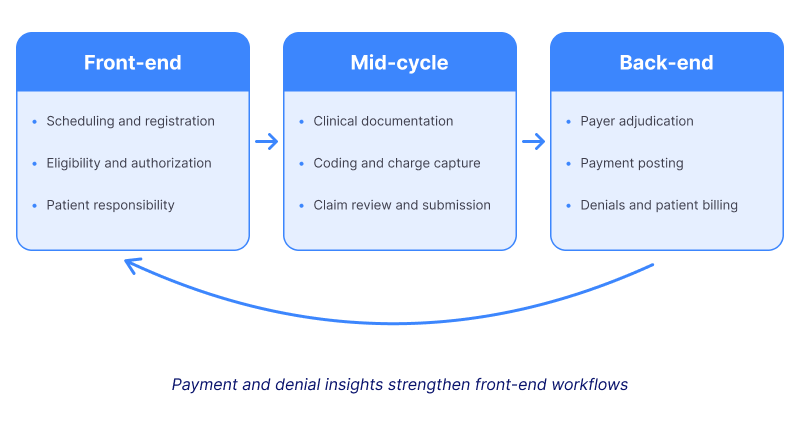
The revenue cycle is the financial path a patient account follows, from the first appointment request to the last balance collected, and it runs in three connected phases. Because each phase depends on the one before it, an error in registration or eligibility rarely stays at the front desk. It resurfaces later as a denied claim, a corrected bill, or a confused patient.
- Front-end. Patient scheduling and registration, insurance eligibility and authorization, and patient responsibility estimates or collection. Every claim is built on the information gathered here, so this is where accuracy costs the least to get right.
- Mid-cycle. Complete clinical documentation, coding and charge capture, claim review, and electronic claim submission. The quality of the visit note shapes the accuracy of the claim.
- Back-end. Payer adjudication, payment posting and reconciliation, denial follow-up or appeals, and patient billing and collections. Patterns you find here, such as recurring denial reasons, should feed back into front-end workflows.
What Are the Steps of the Revenue Cycle?
The revenue cycle management process usually breaks into about seven steps, from registering the patient to resolving the final balance, though practices and vendors group and name the stages differently. Here is a common way to map them, with who typically owns each step in an independent practice and what goes wrong when information is incomplete.
- Patient registration and scheduling. The front desk captures and confirms demographics and appointment details before the visit. A wrong date of birth or member ID travels onto the claim and comes back as a rejection.
- Insurance verification and eligibility. Front-desk or billing staff confirm active coverage, eligibility, authorization requirements, and expected patient responsibility when applicable. A lapsed policy or missed authorization can turn a completed visit into a denial.
- Clinical documentation, coding, and charge capture. The provider documents the visit, and that record supports the codes and charges billed, often with help from a biller or coder. Incomplete notes lead to coding questions or charges that never get billed.
- Claim preparation and submission. Billing staff assemble the claim, review it for missing or inconsistent information, and submit it to the payer or a clearinghouse. A problem caught here takes minutes to fix, while one the payer catches restarts the cycle.
- Payer adjudication. The payer reviews the claim against coverage and payment rules, then pays it in full, pays part of it, denies it, or asks for more information. Billing staff monitor status, because an untracked claim can sit unresolved until a filing deadline passes.
- Payment posting and reconciliation. Billing staff record payer and patient payments and compare them with expected amounts. Unposted or mismatched payments distort balances and hide underpayments.
- Denial follow-up and patient billing. Billing staff resolves denials or underpayments where appropriate, then bills patients for validated remaining balances. Denials nobody works become lost revenue, and inaccurate patient bills erode trust.
Your practice may combine some of these steps or split them further. What matters is that every handoff has a clear owner.
Why Revenue Cycle Management Matters for an Independent Practice
Revenue cycle management determines whether cash arrives predictably enough to keep your attention on patients rather than on the bank balance. The effects show up in three places. Reliable cash flow depends on claims that go out complete and get followed up until they are paid. Less avoidable rework comes from catching registration and documentation gaps before they turn into denials, which matters most when the same few people run the front desk and the billing. Clearer financial communication means patients learn what they owe before or at the visit, not from an unexpected statement weeks later.
If you’re ready for tactics, see how to improve revenue cycle management without adding staff.
Which RCM Metrics Should a Practice Monitor?
A small set of RCM metrics, tracked the same way every month, shows you where the revenue cycle is slowing before the slowdown reaches your schedule or your patients. These six cover the full cycle:
- Clean claim rate: the share of submitted claims accepted without an error that requires correction before processing. A drop usually sends you back to registration and claim review.
- First-pass resolution rate: the share of claims paid on their first submission, without rework. Reviewing it by payer shows whose rules your claims are missing.
- Denial rate: the share of claims payers deny. Review the reasons behind denials, not only the total, because the root cause tells you which step to fix.
- Days in accounts receivable: the average time it takes to collect payment after a service is provided. A rising number often means follow-up is falling behind.
- Net collection rate: the share of allowable revenue collected after contractual adjustments. It can reveal underpayments that never show up as denials.
- Patient collection rate: the share of patient-responsibility balances collected under your practice’s policies. It reflects how clearly patients learn what they owe, which starts at the front desk.
How to use this list. Watch trends over several months rather than reacting to a single one, investigate any material change, and confirm how your reporting system defines each metric so this quarter’s numbers compare fairly with last quarter’s.
How Connected Clinical and Billing Workflows Support the Revenue Cycle
When scheduling, documentation, charge capture, billing, and follow-up work from the same patient record, your team spends less time re-entering information and more time with patients. Each handoff between those steps is where rework either starts or gets prevented.
Scheduling and intake typically live in practice management software, and the details captured there should carry into the visit without being retyped. The provider then documents in the EHR software, and that documentation feeds coding and charge capture directly, so charges don’t get lost between the exam room and the billing queue. Billing staff submit, track, and follow up from the same record, so a denial points back to the step that caused it.
For product-specific detail on how DrChrono connects these steps, see DrChrono’s medical billing page.
DrChrono reports a 32% increase in same-day claims and 8 minutes saved per visit with EverHealth Scribe and platform workflows.
Build a More Reliable Revenue Cycle, One Workflow at a Time
A more reliable revenue cycle comes down to three habits: understand how the three phases connect, use the seven steps to find the handoffs where information goes missing, and monitor a small set of metrics consistently. That is revenue cycle management explained at a level an independent practice can act on.
To explore workflow support first, see how DrChrono can help you improve revenue management. When you want to see how connected EHR, practice-management, and billing workflows can keep your team focused on patient care, request a DrChrono demo.
Frequently Asked Questions: What Is Revenue Cycle Management?
What Is Revenue Cycle Management in Healthcare?
Revenue cycle management in healthcare is the end-to-end financial process around a patient encounter, from scheduling and eligibility through claim submission, payment posting, and patient billing. It connects front-desk, clinical, and billing work so a practice is paid accurately for the care it provides. In medical billing terms, billing turns the visit into a claim, while RCM also covers what happens before the claim and after the payer responds. The three-phase overview above shows how the stages connect.
What Is the RCM Process?
The RCM process moves a patient account through three phases (front-end, mid-cycle, and back-end) and about seven steps, from registration and eligibility to denial follow-up and patient billing. Each step hands information to the next, so gaps early in the process show up later as denials or rework. See the seven steps of the revenue cycle for detail on each one.
What Does a Revenue Cycle Management Team Handle?
A revenue cycle management team monitors claims, payments, denials, patient balances, and reports, and fixes the workflows behind recurring problems. Responsibilities vary by practice. In an independent practice, this work often falls to a few people who also cover the front desk or office management, sometimes with outside support for selected tasks.


