

Executive Summary
Behavioral healthcare depends on sustained attention. During therapy, clinicians track affect, tolerate silence, and respond with timing and attunement. Even small workflow interruptions can disrupt that process.
Yet many EHR systems introduce exactly those interruptions. Alerts, rigid templates, and navigation demands pull clinicians into task mode during these moments that require relational presence. Over time, these micro-interruptions can weaken trust, alter disclosure patterns, and contribute to clinical burnout.
Technology without interruption is a workflow design approach that reorganizes when and how documentation occurs so clinical and compliance requirements are met without disrupting the therapeutic relationship.
This guide examines where interruptions enter the behavioral health visit lifecycle and outlines a presence-preserving workflow model for session preparation, in-session capture, post-session documentation, and care continuity.
The Therapy Hour Has a Different Operating System: Trust, Attention, and the Cost of Interruption
Every healthcare encounter relies to some degree on the relationship between the provider and patient. However, behavioral health occupies a distinct position on that spectrum. The therapeutic relationship is not a backdrop to treatment—it is the treatment.
Research consistently supports this. One widely cited study published in StatPearls defines a good therapeutic relationship as consisting of “an emotional bond of trust, caring, and respect; agreement on the goals of therapy; and collaboration on the ‘work’ or tasks of the treatment.”
A study featured in the Journal of Counselor Preparation and Supervision cites the therapeutic relationship as one of the strongest predictors of successful treatment outcomes, and that clients who feel secure and trusted are more likely to disclose personal information and explore sensitive topics.
Trust in behavioral health is built through repeated interactions. Silence, pacing, affect tracking, and emotional safety all depend on the clinician staying present during those interactions. When a patient shares something difficult, as the clinician’s eyes drift to a screen, the rupture may be small, but its effects are not.
Micro-interruptions shift disclosure patterns, alter emotional regulation and change how heard the patient feels. In a field where the intervention is relational, attention is not a courtesy. It is a clinical tool.
How Current Trends in Healthcare Are Eroding Patient Trust
Trust in healthcare has been under pressure for years, and the forces acting on it extend well beyond the exam room. A report published in The New England Journal of Medicine in 2014 found that only 58% of American patients believe doctors could be trusted. This places the United States 24th among surveyed countries.
Researchers have attributed this trust erosion in part to the de-prioritization of relationships in modern healthcare delivery. The shift toward fragmented care—where patients see multiple clinicians across settings and data-driven policies shape treatment decisions at a distance—has introduced a sense of impersonality that runs counter to the conditions trust requires.
For behavioral health specifically, these trends carry heightened risk. The vulnerability of individuals seeking mental health care makes trust not just important but essential. Patients navigating anxiety, trauma, depression, or substance use disorders must feel confident that their provider is fully with them, not divided between the person and the system.
And then there is digitization, which is the most pervasive of these trends, and the one most directly present in the room.
The Third Participant in the Room Is the Interface
When an EHR demands constant input during a session, such as clicking, searching, managing alerts, and navigating between tabs, it becomes a third participant in the therapeutic space.
Rigid templates push clinicians toward checkbox completion rather than reflective listening. Alerts and navigation steps create cognitive load that narrows curiosity, reduces follow-up quality, and limits clinical flexibility. Meanwhile, patients form their own interpretations: “They’re not with me.” “I’m being evaluated.” “I’m a task.”
The central problem is not the existence of documentation itself. Documentation is legitimate and necessary. The problem is documentation that’s been designed as an in-session administrative workflow rather than a clinically aligned capture-and-completion workflow. When the tool demands attention at the wrong moment, the clinician is forced into a false tradeoff between completeness and connection.
Many behavioral health sessions now take place virtually—55% of mental health appointments are remote. According to the Association of American Medical Colleges, more than half of U.S. counties currently lack a practicing psychiatrist, and telehealth has become a critical pathway for expanding access to mental health care, especially in rural and underserved communities.
When a session is delivered over video, the EHR interface competes directly with the patient’s face for screen space. In many cases, the clinician is literally switching between the patient’s face and their documentation on the same screen. This makes presence-preserving workflow design not just preferable, but essential for virtual care.
What Presence-Preserving Technology Looks Like in Practice
Presence-preserving technology can’t be found in a specific tool or product. Rather, it’s a set of design principles:
- Care happens in a single flow with fewer tab switches and repeated logins.
- Minimal capture occurs during sensitive parts of the session, with efficient completion immediately after.
- Templates support narrative and clinical reasoning rather than forcing generic structures.
- Patient-facing workflows move preventable administrative work out of the hour.
The goal isn’t to eliminate technology from the room, but to ensure that when technology is present, it fades into the background while the connection stays in the foreground.
Where Behavioral Health Workflows Break Presence, and How to Measure It
Before examining where workflows break down, it’s important to distinguish the behavioral health context from general medicine. Primary care visits average 10 to 15 minutes. By contrast, mental health sessions run 45 to 60 minutes. This structural difference fundamentally changes when and how documentation should occur.
Behavioral health providers collect more intensive data from screening tools and ongoing treatment, rely heavily on care coordination and patient engagement, and operate under data privacy requirements that go beyond standard HIPAA compliance. As one analysis noted, “behavioral health and primary care differ in their language, classifications, codes, data reporting requirements, and regulations.”
Yet most EHR systems weren’t built for this context. They were designed for primary care workflows and adapted, often poorly, for behavioral health. The result is a mismatch between what the software expects and how therapy works. Mental health clinicians tend to see fewer patients per day, for example, since their encounters are longer and more conversational. Despite this, documentation expectations built into most EHRs don’t reflect this rhythm.
Federal data illustrates the gap starkly. According to a 2022 review, only 6% of behavioral health clinics and 29% of substance use disorder treatment centers use EHRs, compared to nearly 80% of office-based physicians in other specialties. The adoption lag is not a coincidence. When tools don’t fit the work, clinicians resist them.
What the Research Shows About EHR Time and After-Hours Work
A study of 573 ambulatory physicians published in the Journal of General Internal Medicine found that those with the most clinical effort spent an average of 2.8 hours on EHR tasks outside of scheduled clinic hours per day. This included weekends and holidays. Among family medicine residents specifically, 33.6% reported spending more than three hours per night on after-hours EHR work, and high “pajama time” was associated with higher odds of burnout.
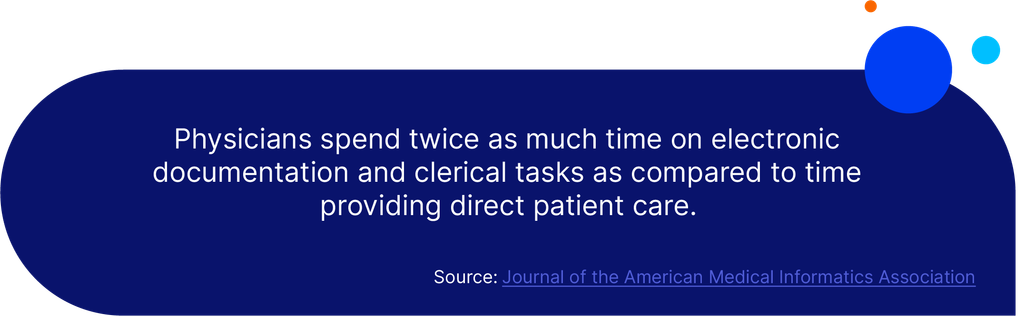
Another study found that 85% of healthcare professionals engage in pajama time, averaging 8.2 hours of after-hours EHR work per week. This equates to more than one full workday each week, or roughly 53 workdays per year. And this is not just an inconvenience. 35% of clinicians surveyed have considered leaving the profession entirely due to EHR-related burnout.
Additional research reinforced these findings, reporting that the pooled prevalence of burnout among healthcare professionals was 40.4%, and that those who spent more time on EHR-related tasks outside of work had 2.43 times higher odds of experiencing burnout.
For behavioral health, where the clinician’s emotional availability is the treatment, this creates a compounding problem: the documentation system that is supposed to support care ends up degrading it.
Why this Matters in Behavioral Health
Behavioral health sessions are unusually sensitive to attention breaks because disclosure, affect, and pacing are central to the intervention. A patient working through trauma who senses their therapist is distracted or burned out may withdraw for the rest of the session or even stop treatment entirely. The measurable workflow problem in behavioral health is not that documentation exists, but that it pulls attention into task mode during clinical moments that require presence.
The measurable outcomes that matter are fewer in-session interruptions, faster note closure, fewer after-hours minutes, and a higher patient-reported sense of clinician presence.
A Framework for Evaluating Whether Technology Preserves Presence
Not every EHR or documentation system will erode the session, and not every feature marketed as “clinician-friendly” will protect the room. What practitioners need is a simple framework for evaluating any technology decision, in the form of a presence test.
Ask the following five questions about any tool or workflow under consideration:
- Attention: Does it steal attention at clinically sensitive moments?
- Rhythm: Does it interrupt pacing, silence, and emotional processing?
- Choice: Does it force a false tradeoff between completeness and connection?
- Cognitive load: Does it create a search/navigation burden inside the session?
- Continuity: Does it help carry the thread between sessions without more admin?
Keep the evaluation practical and focused on actual session experience, not theoretical workflow design. Do you leave sessions with a clear thread to next time? Do you routinely apologize for typing? Do you avoid certain templates because they derail the sessions?
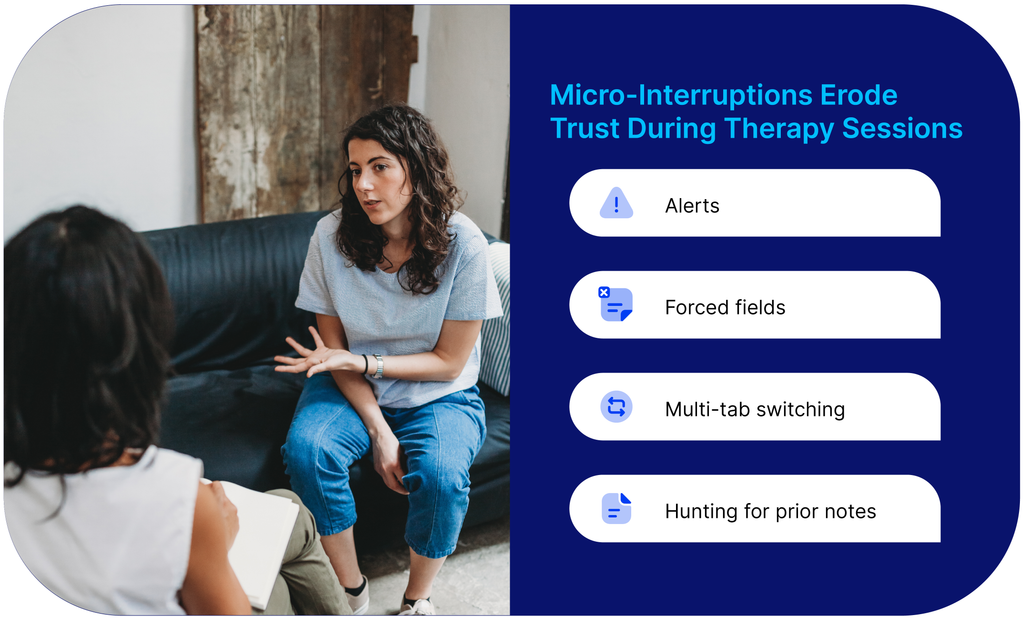
If the answer to any of these is yes, the workflow is intruding. The reality is that technology that creates micro-interruptions can erode trust in behavioral health. The goal is to use technology and processes that do not interrupt care.
Building a Mental Health EHR Workflow that Stays Out of the Session
Technology supports therapeutic presence when it minimizes cognitive switching, reduces in-session navigation, and matches the natural rhythm of therapy. Documentation is strongest when it captures clinical meaning without forcing clinicians to abandon the moment to satisfy the tool. With this in mind, below is a presence-preserving workflow model organized around the behavioral health visit lifecycle.
Session Preparation
Pre-visit digital workflows reduce disruptions by moving predictable tasks out of the clinical encounter. The design principle is simple: anything the patient can complete independently before the appointment shouldn’t consume time during the session.
Patient-facing portals and digital check-in tools make a smoother pre-session experience possible at scale. Automated reminders and guided digital workflows help patients complete pre-appointment requirements before the visit. Integrated patient portals ensure patient information is updated automatically.
For virtual sessions, these workflows are especially important. When a patient logs in and has already completed their forms digitally, the telehealth session can begin with a clinical focus rather than logistical setup.
Completing documentation work beforehand also reduces appointment no-shows, which are more prevalent in behavioral healthcare. According to a study published in the Journal of Psychiatric Practice, psychiatric clinics report higher average no-show rates (22%) than the typical non-psychiatric practice.
Completing paperwork beforehand serves as an appointment commitment. Patients who don’t fill out the documentation are an early warning sign of a no-show. Administrative staff can then send that patient a confirmation call or text to confirm the appointment or reschedule.
Consent and Intake
Consent is a clinical and legal necessity, but it shouldn’t be reinvented for each visit. Standardizing consent workflows reduces manual work for staff and removes one more source of in-session friction. This includes attaching consent forms to new appointment types by default and using required-consent gating so check-in cannot proceed without completion.
Modern EHR systems allow practices to standardize consent workflows, attach forms to appointment types by default, and require completion before check-in. Platforms such as DrChrono support this type of automated consent management.
In-Session Presence
During the session itself, documentation should be reduced to what’s known as “anchor” capture. This refers to the minimum notes required at the moment to ensure safety and continuity. Examples include a brief keyword, a risk flag, or a medication change. All other documentation can wait for the structured post-session window.
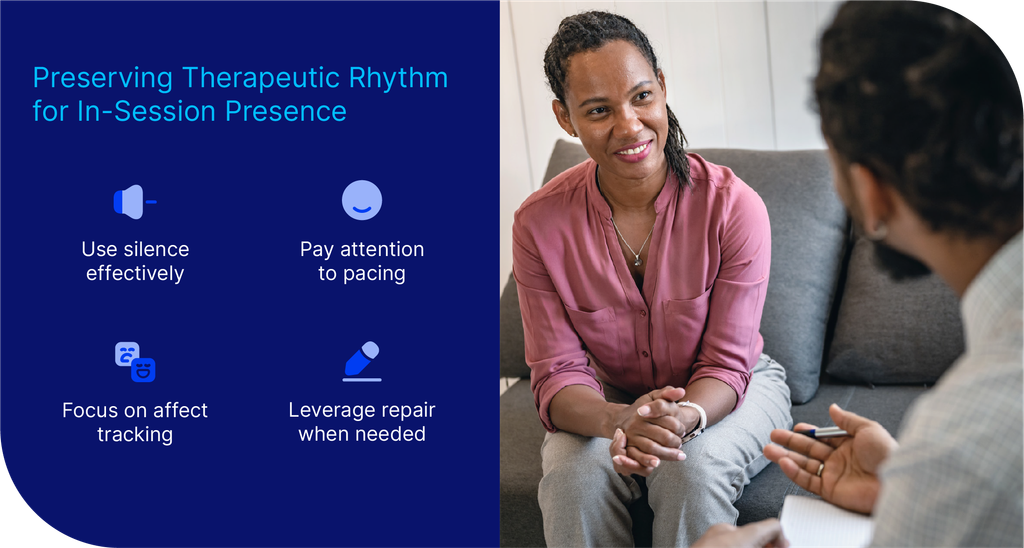
The therapeutic rhythm, including silence, pacing, affect tracking, and repair, shouldn’t be interrupted by prolonged typing or template navigation.
Documentation helpers can reduce friction without breaking attention. Text-expansion macros, for example, allow clinicians to insert frequently-used phrases with a few keystrokes in free-text fields. The American Academy of Family Physicians (AAFP) explains that macros can be set up to insert a single word, phrase, or an entire block of text. These can serve as a template for common visit types.
Furthermore, research published in ScienceDirect shows that physicians favor macros and shortcut keystrokes as productivity-enhancing documentation tools. The American College of Emergency Physicians (ACEP) likewise recommends that the appropriate use of shortcuts, including macros, should be encouraged. Many modern EHR platforms support macros for faster, less disruptive capture in free-text fields.
The key design principle is that any in-session tool should require less attention than the clinical moment demands. Otherwise, it’s not helping. For telehealth sessions, where the clinician’s gaze is the primary signal of engagement, even brief glances away from the camera to type or navigate carry relational weight that patients register immediately.
Post-Session Documentation
The period immediately after a session is the most valuable documentation window. Clinical impressions are fresh, emotional nuance is still accessible, and narrative synthesis is possible. Protecting even five to ten minutes after each session to complete notes dramatically reduces after-hours spillover.
Use post-session time to turn anchor notes into coherent clinical records by reviewing each anchor, writing the narrative, updating the treatment plan if needed, and closing the note. The goal should be same-day note closure whenever possible. As discussed earlier, excessive “pajama” time has been linked to increased risk of burnout. Every note that carries over into the evening contributes to this problem.
Care Continuity
Between sessions, the administrative overhead of reminders, rescheduling, and follow-up can pull clinicians back into task mode. Automated appointment reminders reduce no-show rates and downstream rescheduling loads.
Additionally, understanding what delivery and verification statuses mean—whether a reminder was sent, received, or bounced—allows staff to troubleshoot quickly instead of chasing patients manually. Practices that implement reliable reminder systems free up clinical and administrative time that can be redirected toward care. DrChrono provides detailed reminder status tracking so teams can verify whether reminders were delivered and troubleshoot patient contact information issues quickly.
For behavioral health specifically, care continuity also means maintaining the narrative thread between sessions. When a clinician can open prior notes, see the anchors from last time, and enter the new session with context already loaded, the patient benefits from a sense of being known.
Implementation Guidance
Start small. Choose one appointment type, such as follow-ups, intakes, or medication checks, and redesign the workflow for that type first. Move one high-friction step out of the hour, such as consent collection or pre-visit forms. Reduce in-session documentation to anchors and protect post-session completion time. Review your signals after two to four weeks, then adjust.
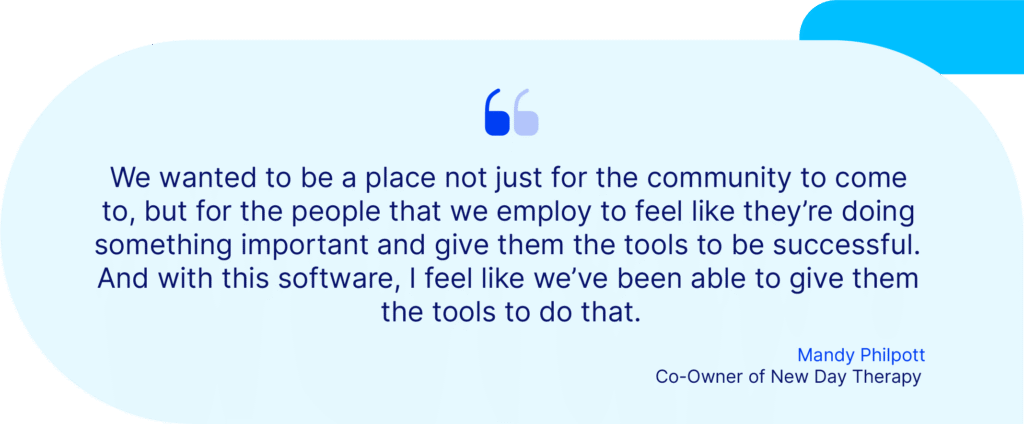
Define success in human terms: fewer lost moments or apologies for typing. If your current EHR platform doesn’t support these workflows, it may be time to evaluate alternatives. Some practices have addressed this challenge by redesigning workflows alongside EHR implementation. For example, NewDay Therapy reported spending less time on paperwork and more time on patient care after adopting DrChrono.
Technology Without Interruption Should Be a Priority in Behavioral Health
Trust in behavioral health is built through consistent presence. It’s nurtured minute by minute, session by session. When documentation and administrative tasks are forced into the therapy hour, clinicians are pushed into task mode, patients experience the rupture, and “counseling session documentation” becomes a barrier rather than a record of care.
The goal shouldn’t be less documentation, but rather better-designed behavioral health workflows in which technology fades into the background while connection remains in the foreground.
Presence-preserving workflows remove the false tradeoff between documentation completeness and human connection, while reducing after-hours charting that drives clinician burnout. The framework in this report gives behavioral health leaders a practical lens for every technology decision.
But the opportunity extends beyond any single practice. As behavioral health demand continues to outpace workforce supply, the field cannot afford to lose clinicians to preventable burnout or lose patients to fractured trust. Designing technology and workflows that protect the therapy hour is not just an operational upgrade—it’s a clinical imperative.
EHR platforms that support flexible documentation, automation, and integrated telehealth can help behavioral health practices implement these workflows. DrChrono is one example of a platform designed to support this type of behavioral health workflow.
To explore how DrChrono can support your practice, download our guide to Choosing the right EHR for Your Psychiatry Practice.