

Most pediatric practices are using primary care workflows that were not designed for them. Care for children and adults is fundamentally different, but many pediatric and family practices rely on management and EHR systems built for adult care workflows.
Day-to-day, this means pediatricians enter well-child visit data into growth charts that adult primary care practices never touch. High-frequency schedules for vaccines that adults don’t need require manual tracking, while appointment coordination revolves around family units, not just individual patients. All these processes take place in EHR systems designed for episodic adult care, a fundamental mismatch that costs practices efficiency in the short term and, more importantly, the ability to grow.
From birth through to adolescent years, care structure focuses on longitudinal development and preventive milestones such as immunization schedules rather than the largely episodic treatment cycles seen in adult care. The American Academy of Pediatrics recommends 31 well-child visits before the age of 21, including seven visits in the first year alone. This results in a much higher throughput of appointments for pediatric practices, with the CDC finding that 95.1% of children have visited a healthcare professional within the last 12 months.
In this scenario, however, most providers are still relying on patchwork systems and manual workarounds to keep up with documentation, communication, and billing processes. Standard EHRs leave large gaps across key areas that pediatricians and their support staff must fill manually. These constraints have a wide-ranging impact. Long after-work hours to keep up with documentation and extended day-to-day processes to manage workarounds leave little room for focusing on practice growth.
EHR systems designed specifically for pediatric workflows and care models provide a fundamentally different operational approach. They combine everything from documentation and family-centric scheduling to immunization tracking and alerts to transform how providers deliver and manage pediatric care.
This paper will examine in detail why standard EHR systems fall short for pediatric practices, and what changes pediatricians can expect when using technology built for their specific needs instead.
Why Pediatrics Is Not Just a Variation of Adult Care
Because pediatricians spend much of their time dealing with routine appointments and treatments, pediatrics is sometimes categorized as a variation on primary care. But it follows a fundamentally different structure and places unique operational demands on practices.
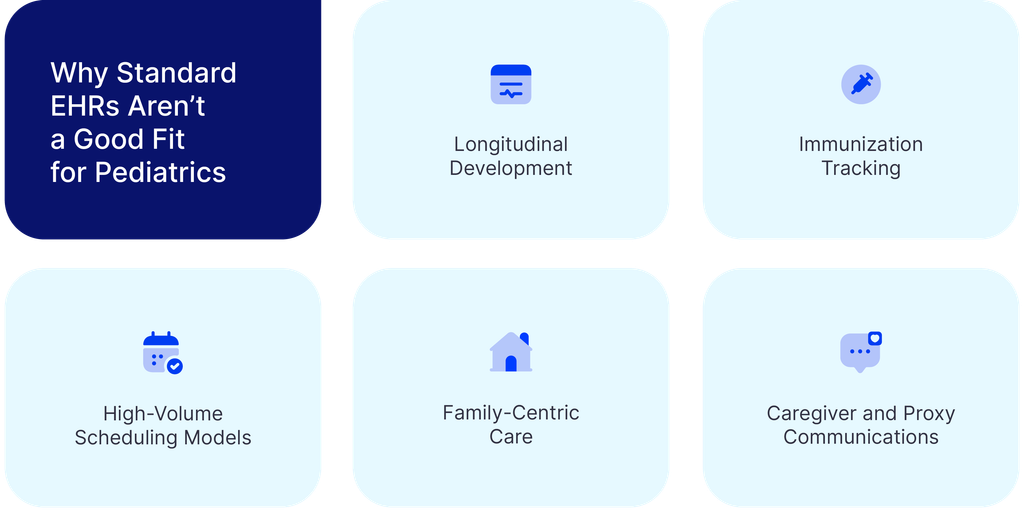
Longitudinal Development
Pediatric care revolves around progression over time, structured around standardized milestones and required check-ins. Adult care focuses on episodic treatment, diagnosing and resolving individual conditions. Even when adults schedule regular checkups, they are routine and, individual patient history aside, largely similar.
The longitudinal structure of pediatrics means every appointment looks different and the overall cadence of care is more frequent. The American Academy of Pediatrics recommends seven preventive visits in the first year alone and three in the second. Beyond infancy, annual visits remain part of a broader longitudinal record to track development over time.
At each stage, pediatricians must record and interpret milestone data like growth measurements and developmental screenings across behavioral and cognitive indicators. Documentation requires consistency so that providers can clearly compare between visits and track development accurately. In comparison, adult care typically revolves around a specific condition or individual appointment.
Requirements specific to childhood development, like immunization schedules, add another layer of complexity to pediatric workflows and documentation. The CDC’s children’s immunization schedule includes over 15 age-based vaccines from birth to 18 years. Each vaccine comes with defined intervals and combinations, with documentation closely and accurately tracking administered shots and overdue appointments.
High-Volume Scheduling Models
The level of scheduling density in pediatric practices is much higher than in adult care. Adults might schedule regular six-month or annual check-ups, and many visit their primary care provider only when experiencing symptoms. In a pediatric practice, schedules center around high visit volumes per patient and quicker turnover throughout the day.
Back-to-back well visits, particularly in infancy, contribute to this model. But pediatric practices also need to accommodate same-day sick visits at short notice or deal with seasonal surges driven by close proximity in school environments. The CDC reports that 5.9% of children in 2024 aged 5-11 missed 11 or more days of school due to illness. These combinations lead to practice days with tightly packed schedules that also need the flexibility to absorb unexpected visits.
Unlike individual adult patients, children’s appointments often happen based on a family unit with multiple siblings scheduling appointments together. The need for family-level coordination across varying developmental and immunization schedules creates extra administrative work, particularly when practices rely on EHR systems not equipped for this type of appointment clustering.
Family-Centric Care
Another key element of family-based care models in pediatrics is the transfer and access of information and documentation. Caregivers often need access to the schedule and records of multiple children within the home. Some family units may require sharing with multiple caregivers, each with different roles and permissions. In contrast, adult care means sharing individual appointments and records directly with the patient alone in most circumstances.
These ongoing interactions can include sharing visit summaries, organizing follow-ups and vaccination schedules, sending reminders, managing forms, and responding to caregiver questions. Rather than an individual thread relating to specific conditions or concerns like in adult care, parents and guardians typically need communication across multiple threads and patients.
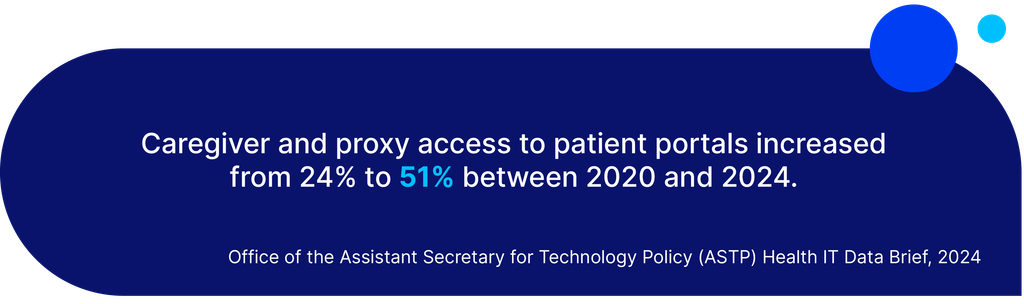
The demand for centralized access to this information and communication is on the rise, with one study published by the National Library of Medicine finding that caregiver and proxy access to patient portals increased from 24% to 51% between 2020 and 2024. Despite this, another National Library of Medicine study found that only 26% of family communications come through secure messaging through a portal or app, even though caregivers name this as their top communication preference.
Without dedicated portals that integrate fully with documentation and billing systems, many pediatric practices maintain this communication through phone calls and emails or manual follow-ups and reminders.
Standard EHR Systems Create Unnecessary Friction in Pediatric Practice
All of these demands converge in a typical day within pediatric practices. Providers might start with a series of back-to-back well-child visits in the morning before a surge of unexpected same-day sick appointments in the afternoon. Meanwhile, time-sensitive messages come through from caregivers in the communication portal while the front desk deals with complex scheduling to align different appointment types for multiple children in the same household. Over a brief lunch break, providers sit busily updating documentation, growth charts, and immunization records.
None of these challenges are unusual, but how practices manage them with standard EHR systems reflects the fundamental differences between pediatric and adult care and the systemic operational challenges this creates.
High Operational and Administrative Burdens
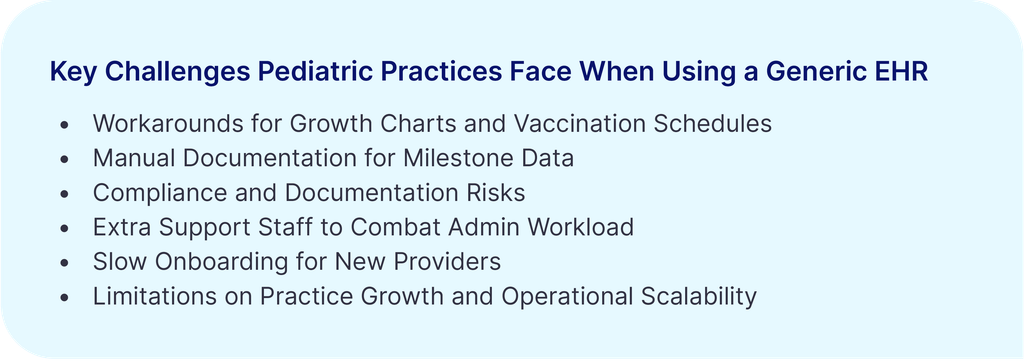
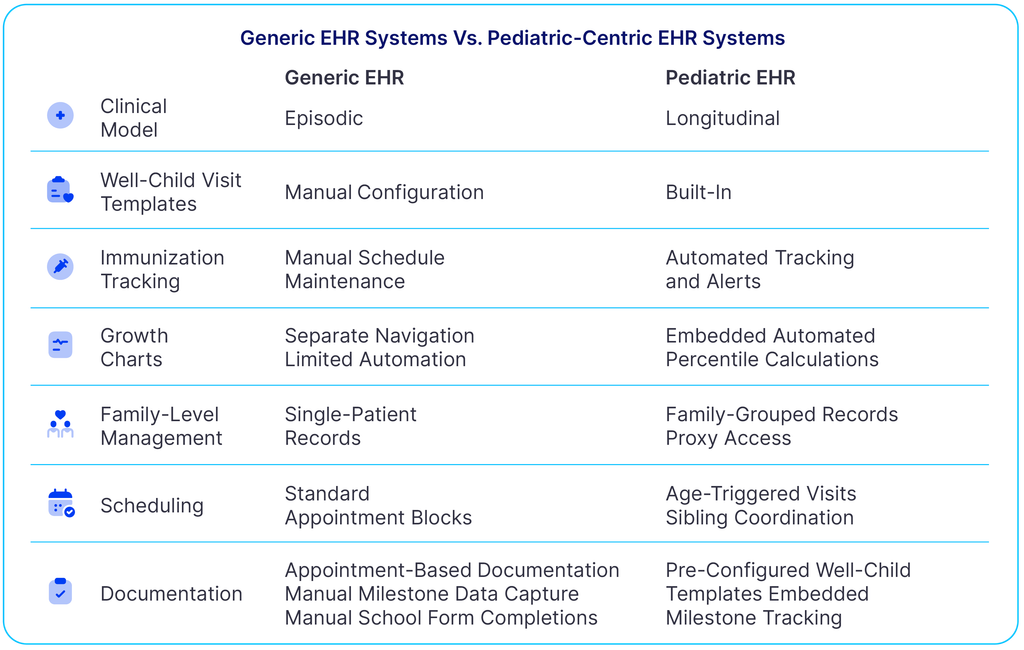
In standard practice appointments, EHR systems are pre-built to capture the type of episodic care adults generally seek. When it comes to pediatric care, practices find themselves engaging in manual workarounds and extensive customization to make these systems work for them.
For example, a well-child visit might mean navigating away from primary charts to create or access separate growth charts and manually entering or reconciling data. Immunization schedules and tracking then require another screen completely. What should be a continuous, logical workflow becomes a series of extra steps and clicks.
On the surface, some of these workarounds might not seem complicated. But scaled across a packed schedule, they compound quickly into extra cost burdens, with practices relying on extra work hours and staffing to compensate at a time when workforce constraints are on the rise. In 2024, the Association of American Medical Colleges reported that the pediatric match was the lowest it has been in 30 years, and many residency slots in pediatrics remained unfilled. In the same year, the American Medical Association found that pediatricians were reporting a 52.8-hour work week on average and eight hours per week on EHR work outside working hours.
EHR systems built specifically for pediatric care alleviate a lot of this friction. These systems provide workflows standardized for pediatric care, with processes for growth charts, immunization tracking, and family-based scheduling reducing clicks and manual workarounds in-appointment and at the front desk.
Compliance and Documentation Risks
In pediatrics, preventive care and structured reporting are central to delivery. While standard EHRs present operational burdens, they can also bring significant compliance risks. For example, the CDC requires a detailed schedule of vaccinations based on age and prior vaccinations. As of 2024, reporting on the Child Core Set is now mandatory in all states. In 2026, this includes a wide range of checks and data recordings, including:
- A schedule of well-child visits based on age milestones
- Developmental screening
- Weight and nutrition counselling
- Immunization status
- Lead screening
- Condition-specific follow-ups (e.g., mental health interventions)
With a standard EHR, many of these data points may be recorded through free-text fields or spread across multiple systems. Without a single source of truth, compliance reporting becomes significantly more complex, while workarounds and manual documentation introduce the risk of misreporting or the need for extra hours to reconcile data.
EHR systems designed for pediatrics resolve many of these risks of incorrect or incomplete data. With standardized data through appointment and documentation templates, practices can reduce the risk of incomplete or missing data for compliance reporting.
Limitations on Practice Growth
Practices certainly feel the limitations of a standard EHR system day to day. But when practices are dealing with manual data entry and reconciliation, workarounds across systems, and the staffing levels required to keep up, it can limit their ability to grow the practice.
At an individual provider level, the extra steps for documentation and appointment workflows reduce their daily capacity for appointments. This places a ceiling on the revenue a pediatric practice can expect to generate year over year.
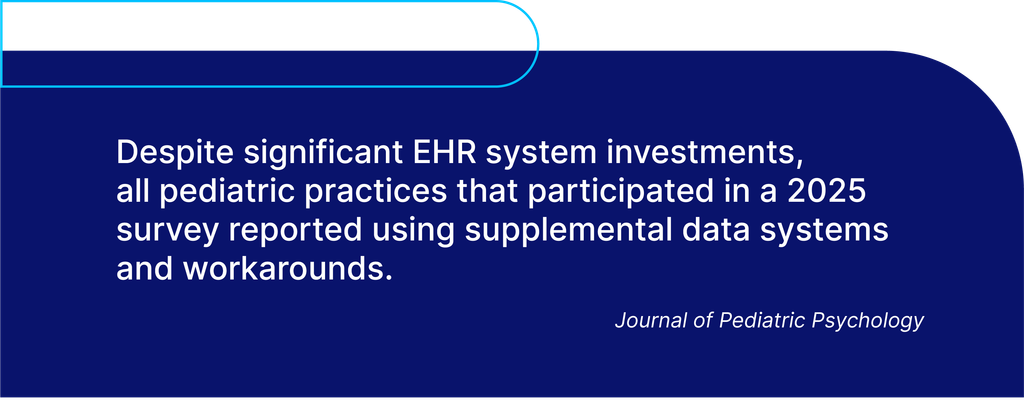
Even as patient volume grows and a small or single-provider practice looks towards expansion, the operational burden simply grows alongside provider or location numbers. A 2025 study published by the National Library of Medicine found that all pediatricians surveyed had invested significantly in EHR systems but were still using supplemental data systems and workarounds to fill functionality gaps.
Filling the gaps with extra staffing also becomes unsustainable or even unfeasible. The American Academy of Pediatrics found in 2024 that 88.9% of pediatric facilities had support staff shortages and over half had physician shortages.
Dedicated pediatric EHR systems give practices both the insight and operational capacity to scale more sustainably and predictably. Standardized workflows and data fields across appointments and scheduling enable insights into visit volumes and bottlenecks. Built-in workflows and templates make onboarding easier, while family-oriented scheduling lifts pressure off front office staff.
How Technology Tailored for Pediatrics Transforms Practice Efficiency
The challenges pediatric practices experience are not the result of poor processes or inefficient teams. When there are fundamental mismatches between how a practice runs and the system the team uses to run it, workarounds and manual tasks become the only way to bridge the gap.
But dedicated pediatric EHR and billing systems like DrChrono integrate workflows in one place, so providers can focus on patient care and growth instead.
Adapted for Pediatric Timelines
Many standard EHR systems come with templates for managing appointments and documentation, capturing data and integrating with billing to improve operational efficiency. The problem is, they work along episodic timelines with adult appointments in mind. Whether for primary care or a specialty, they revolve around one-off instances or treatment of specific conditions.
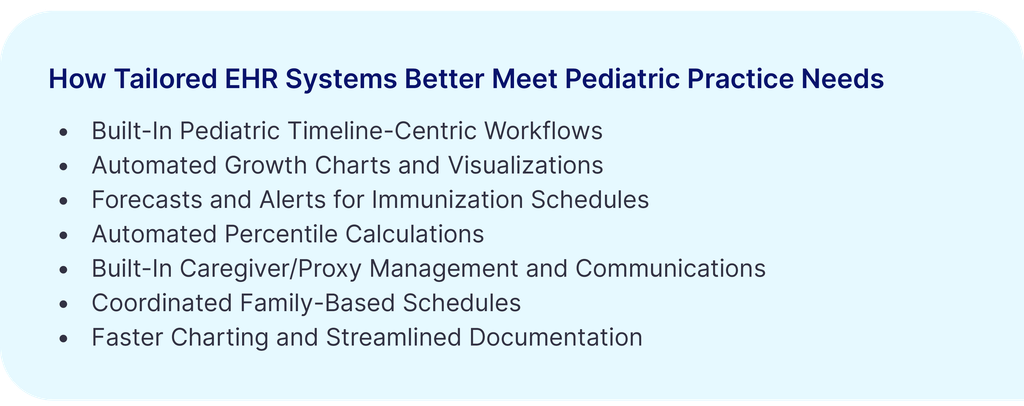
Platforms designed for pediatrics like DrChrono have child-centric longitudinal timelines baked into workflows already. Rather than clicking between screens and spending extra time note-taking during the appointment and doing extra charting after, pediatric physicians can leverage child visit templates with fields for age-specific milestones.
Physicians and front office teams can also lean on automated age-based triggers to schedule screenings and trigger reminders. Rather than keeping track of children’s ages and workarounds to stay compliant and on schedule, pediatric EHR systems take care of these processes for you based on the patient’s age and history.
With all of this happening in one system, pediatricians can easily access a central view of a patient’s history and upcoming appointment requirements in one unified record.
Embedded Infrastructure for Growth and Immunization
Growth tracking and childhood immunizations are only relevant to pediatrics. So, in most EHR systems, there are no readily available fields or workflows to document or track these schedules. This leaves providers moving between charts or even manually calculating percentiles, often outside of work hours long after the visit itself.
Pediatric EHR systems embed these fields right into the platform. Providers get out-of-the-box functionality like growth charts where they can immediately visualize dimensions like height and weight against standardized curves. The system handles percentile calculations and benchmarks, so providers can spend more time on appointments and patient care while knowing that all charting and documentation are consistent across the practice.
On the immunization side, pediatric EHR systems like DrChrono integrate vaccine schedules directly into the patient record. Practices can rely on scheduling logic to forecast appointments based on age and prior doses rather than checking external schedules or separate tools. Within one centralized record, providers can see administered vaccines with upcoming or overdue doses automatically flagged.
Where providers or front office staff might previously manage immunization tracking and appointment scheduling with spreadsheets or inconsistent data across records, pediatric EHR systems alleviate this administrative burden and keep growth tracking and immunization schedules on track and compliant.
Built-In Architecture for Family Relationships
For households with multiple children across different growth and immunization schedules, separate records make it exceptionally difficult for families and front office staff alike to manage appointments in a standard system.
Pediatric EHR platforms embed familial relationships into their architecture. Rather than relying on awkward workarounds to link patient records, DrChrono makes it easy to link children’s records to centrally manage scheduling and appointment reminders.
Many pediatric practices also struggle to manage caregiver communication. In the context of proxy access, and especially when there are multiple children in a household, using phone calls and multiple email threads for parent updates becomes unmanageable and inefficient. With pediatric EHR systems, practices can use built-in communication portals for the entire household. This means less time spent on follow-ups and clarifications for each child, and a more secure and efficient process for caregivers.
Pediatric EHR systems embed these multi-child structures as part of their infrastructure. Between combined records and the parent communication portal, practices can forecast family schedules and maintain a clear view of both individual patients and broader family context.
Ability to Manage High Visit Density
Pediatric practices operate at a fast pace, and most standard EHR systems cannot support it with standardized scheduling, documentation, and billing processes. High volumes of back-to-back visits are one thing, but with seasonal fluxes in sick-child visits and same-day appointments, schedules need to be both fast and flexible.
With standard EHR systems, a provider might spend all day on a high throughput of appointments. Documentation or charting completion is then waiting for them at the end of the day outside work hours. But with pediatric EHR systems like DrChrono, automated documentation and child-specific visit templates mean less time clicking during appointments and charting after hours to better manage the high volume of daily visits.
Automated scheduling logic also better equips the practice to absorb scheduling changes and same-day fluctuations. The system handles cancellations and gaps and provides insights into visit trends so practices can better predict spikes and plan accordingly. With billing fully integrated to incorporate the nuances of pediatric coding, the system also reduces delays and improves claim accuracy.
Pediatric EHR systems connect scheduling, documentation, and billing, resulting in less need for manual coordination between providers and front and back office staff. Updates that happen in one area reflect automatically in other workflows. This allows practices to reduce costs of additional admin work and maintain higher visit volumes to improve revenue sustainability and predictability.
Pediatric Practice KPIs to Measure What Matters
Standard systems typically require workarounds that “break” workflows, leaving data spread across different systems and spreadsheets. Lack of standardization for pediatric-specific fields and billing codes also makes the data inconsistent and difficult to synthesize.
Pediatric EHR systems like DrChrono ensure that data standardization and collation happen automatically in the background. With this in place, practices can quickly and easily access dashboards and key metrics to surface trends across:
- Visits per provider
- Completion or gaps in well-child visit rates
- Immunization compliance
- Same-day appointment fill rates
- No-shows
- Sick visit rates
- Spikes and dips across timelines
- Family engagement
- Documentation time per visit
For example, many practices operate towards a target of 28-35 visits per day per provider in pediatrics (compared to 15-20 in adult primary care). Whether the practice overall or specific providers are hitting these metrics directly impacts revenue. It might be possible to see this in some standard EHR systems. But, critically, pediatric EHR systems enable you to drill down into the “why” operationally if the practice is not hitting key metrics like this.
Looking Forward: The Future of Pediatric Practice Technology
Beyond centralizing operations and data, technology is advancing to provide extra opportunities for efficiency gains and growth levers in pediatric care.
Telehealth, for example, is quickly becoming a routine aspect of care delivery in pediatrics. One Pediatric Pulmonology study found that 95% of patients and caregivers considered telehealth an acceptable alternative, with 71% finding it more convenient and 94% saying they would use it again. One study published by the JAMA Health Forum also found that, across an analysis of over 800,000 pediatric appointments, clinical outcomes were broadly comparable to in-person visits. Telehealth provides flexibility in appointment scheduling and reduces front office admin, an especially important development with the high throughput experienced in pediatric care.
Like many sectors, AI is also beginning to have a measurable impact. This is particularly felt in areas like documentation, where workflows benefit from technology like AI scribes. One study published by the National Institutes of Health found that using digital scribes in pediatric appointments saved 2.8 minutes on average per appointment on documentation time, with some providers experiencing up to 20.9% in time savings.
As these technologies mature, a strong technological foundation through a dedicated pediatric EHR system enables practices to embed these capabilities into their day-to-day and maximize their impact.
A Pediatric EHR Experience for Stability and Growth
Pediatric care operates under a unique set of operational demands that standard EHRs are not built to facilitate. High throughput of visits and family-centric appointments make scheduling a challenge, with higher rates of fluctuations due to sick visits and seasonal spikes adding further strain. In appointments, providers must contend with extra clicks and manual workarounds in systems designed for episodic, adult care.
Challenges like these compound to increase the costs and complexity of operations, all while limiting the practice’s ability to grow.
Instead of navigating multiple systems to manage everything from scheduling and caregiver communication to documentation and billing, a dedicated pediatric EHR system like DrChrono provides a new way of working. It ensures providers, front office staff, and billing teams can move through streamlined workflows with consistent data outputs that reflect their real-world day-to-day.
Bring scheduling, charting, billing, and patient communication together in one connected platform for your pediatric practice. Learn more about DrChrono’s all-in-one EHR and billing for pediatric care.