



Denial management is the repeatable process of finding out why a payer didn’t pay a claim, correcting or appealing the claim when appropriate, and changing the workflow that led to the denial. For an independent practice, unresolved denials pile up as administrative work and delay payment, and that time comes out of patient care.
This guide covers denial management in healthcare for solo physicians and independent practices, organized as a four-part lifecycle: Identify, Analyze, Resolve or Appeal, and Prevent.
What Is Denial Management in Healthcare?
Denial management is the ongoing work of resolving denied claims and removing the causes behind them, so your team spends less time on rework and more time with patients. In medical billing, it is one part of the broader revenue cycle management process, not a one-time resubmission task. A good process uses payer responses and your own practice data to decide which denials to work first and which root causes to fix.
- Identify: find denied claims quickly in payer responses and claim status.
- Analyze: group denials to find the causes that keep recurring.
- Resolve or appeal: correct, resubmit, or appeal when the claim is supportable.
- Prevent: change the earlier workflow step so the same denial stops coming back.
Claim Rejections vs. Claim Denials: What Is the Difference?
Rejections and denials need different responses, so sorting them correctly keeps your team from working the wrong fix. A claim rejection is an issue identified before the claim completes payer adjudication, often a data or formatting problem. A claim denial is a payer’s decision not to pay all or part of a claim it has adjudicated.
| Claim rejection | Claim denial | |
| Timing | Before the claim completes payer adjudication | After the payer adjudicates the claim |
| Typical next step | Correct the error and resubmit | Correct and resubmit, or appeal, depending on the reason and payer rules |
| Where you find the message | Clearinghouse or payer acknowledgment reports | Remittance advice, such as an ERA or EOB |
Payers and clearinghouses don’t all use identical terminology, so confirm how yours label each type of response.
Types of Medical Billing Denials to Track
Sorting claim denials into categories shows your team which to correct, which to appeal, and which point to a workflow worth fixing. There is no universal top-10 list of medical billing denials, so let your own remittance data set the priorities. Most fall into two broad groups.
Administrative and Technical Denials
These come from the business side of the claim: missing or inconsistent patient or policy information, eligibility issues, timely filing limits, duplicate-claim flags, and data-entry errors. Many can be corrected and resubmitted, subject to the payer’s rules and deadlines.
Clinical, Coding, and Coverage Denials
These involve what was documented, coded, or covered: documentation that doesn’t support the service, coding or modifier issues, medical-necessity determinations, missing prior authorization, and coverage limitations. Resolving them often takes clinicians, coders, and billers working together, and the right fix depends on payer-specific policy.
The Denial Management Lifecycle: Identify, Analyze, Resolve, and Prevent
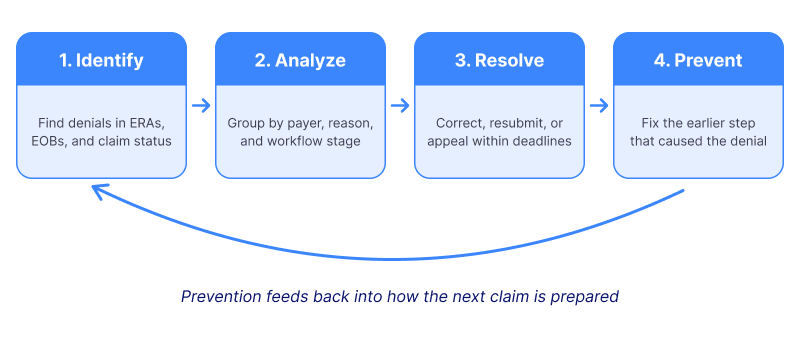
A lifecycle turns denial follow-up from a pile of one-off fixes into a process your team can run every week, so each denial has an owner and each pattern gets addressed.
1. Identify Denied Claims Quickly
The sooner a denial is found, the more time your team has to fix it before payer deadlines. Review payer remittance information, EOBs or ERAs, clearinghouse messages, and claim status on a regular schedule, and give one person ownership of the review. Payment posting in medical billing can surface payer responses that need follow-up, and a connected claims management platform can give your practice a clearer view of claim status and follow-up work.
Track each denial in a work queue with the basics: payer, patient, service date, amount, reason information, deadline, and status.
2. Analyze the Root Cause
Fixing a cause once saves your team from fixing the same denial every month. Group denials by payer, reason, code, provider, location, and workflow stage to see which issues recur. For example, a run of eligibility-related denials from one payer may point to a front-end verification step that needs review.
3. Resolve or Appeal the Claim
Each denial follows one of three paths: correct and resubmit when the payer allows it, supply information the payer requested, or appeal when the claim is supportable and payer policy permits. Payer deadlines and documentation requirements drive every decision, so record what was done, when, and by whom to keep a complete audit trail.
4. Prevent Similar Denials
Prevention is where denial management gives time back to your team and your patients, because every avoidable denial is follow-up nobody has to do. When a pattern recurs, update the workflow that comes before it: intake, eligibility, authorization, documentation, coding, charge capture, or claim scrubbing. Reviewing how to reduce front-end claim errors shows your practice where avoidable issues start before a claim is submitted. Ask these questions each month:
- Which denial category recurred most often?
- Which workflow step happens just before those claims are submitted?
- Who owns that step, and what would change it?
- Did last month’s fix reduce the pattern?
How to Reduce Claim Denials in an Independent Practice
Reducing claim denials starts before submission, so your team catches problems while the details are still easy to confirm. Follow the claim through your workflow:
- Verify coverage. Confirm active coverage before the visit, not after the claim comes back.
- Confirm authorization requirements. Check whether the service needs prior authorization, and document it.
- Document clearly. Complete notes support the codes billed and any appeal that follows.
- Validate codes and modifiers. Review coding against the documentation before the claim goes out.
- Submit clean claims. Check each claim for missing or inconsistent information before submission.
- Monitor payer responses. Review rejections, denials, and claim status on a set schedule.
- Use denial trends to improve the earlier step. Feed what you learn back into the first five steps.
These steps reduce avoidable errors. They don’t guarantee payment or eliminate denials in medical billing, because payer decisions also depend on coverage and policy.
When a Practice Needs Additional Support with Denial Management
Some practices can’t work denials consistently in-house. The owner or a small team runs out of hours, recurring reasons stay hidden, or complex follow-up needs coding and billing expertise. Denials then age, payment slows, and the time cost lands on the people who should be with patients.
There are two broad ways to add capacity. Denial management software organizes claims work so your team can see and prioritize it, while managed billing support, often called denial management services, puts an outside team on the follow-up itself. Connected clinical and billing records also cut manual handoffs, as integrated medical billing in EHR software shows.
For practices that need connected billing tools and hands-on billing support, explore DrChrono’s medical billing offering. Practices that want a team to manage the full claim lifecycle can also learn about DrChrono RCM services.
See DrChrono in action to explore how connected billing and revenue cycle tools fit into your workflow.
Explore DrChrono for Denial Management
When denial follow-up is taking time away from your patients and your team, see how DrChrono connects billing, claims tracking, and revenue cycle support in one workflow, so you can focus on patient care.
Learn more about DrChrono RCM services
Frequently Asked Questions: Denial Management in Healthcare
What Are the Three Types of Claim Denials?
Classifications vary by payer and practice, but a useful practical split is administrative or technical denials, clinical or coverage denials, and coding or documentation-related denials. Treat it as a working framework for sorting your own denials, not a universal payer taxonomy.
How Can RCM Services Help Mitigate Denials?
RCM services put an outside billing team on the work that keeps denials from piling up: reviewing payer responses, prioritizing follow-up, investigating root causes, coordinating corrections or appeals, and reporting recurring patterns so earlier workflows can change. Results depend on your payers, specialty, and workflows, so ask any provider which tasks they own and what reporting you’ll receive.


