

Patient loss is not primarily driven by insurance networks or location. Instead, experience matters more than ever. A 2017 patient survey shared by the Medical Group Management Association (MGMA) revealed that one in eight patients had left their primary care provider sometime in the previous year. The top reasons for leaving had nothing to do with insurance changes or provider dissatisfaction. Nearly 40% left their practice because of poor customer service, poor communication, or difficulty scheduling.
A 2021 review of patient experience studies published in the Journal of Healthcare Management also found a clear link between a positive experience and a willingness to return to a provider for care, and a 2025 article published in the Journal of Brown Hospital Medicine notes that patient experience has become a “central dimension of healthcare quality.”
In response to this shift, large health systems and retail healthcare providers have been investing heavily in digital-first experiences that attract patients. This makes independent practices that aren’t investing in patient experience innovation increasingly vulnerable to patient leakage. These practices often don’t know they’re losing patients until significant damage is done—and the competitive experience gap has already widened.
Independent practices can still compete with larger medical groups and healthcare systems. According to the patient survey mentioned earlier, smaller practices have an 18% higher patient retention rate when compared to large clinics. Patients of independent practices were also far more likely to refer a friend.
The challenge for smaller practices with smaller budgets is trying to keep up with what larger hospital systems are capable of offering today. Patient retention requires matching competitor experience quality across scheduling, communication, follow-up, and connected care. This paper provides a framework to achieve operational excellence across the entire patient journey, so independent practices can retain patients and maintain long-term revenue stability in a patient-experience environment that’s becoming increasingly competitive. The gaps driving that leakage fall into four operational areas: scheduling friction, communication gaps, digital experience deficits, and care continuity failures—each one fixable with the right infrastructure.
The Market Is Reshaping Around Consolidation, but Independent Practices Can Still Retain Patients
Independent practices aren’t competing with the doctor across town anymore. Instead, they’re competing with consolidated systems that have absorbed most of the profession. According to the U.S. Government Accountability Office (GAO), 47% of physicians in 2024 were consolidated with hospital systems. This figure stood at only 30% in 2012.
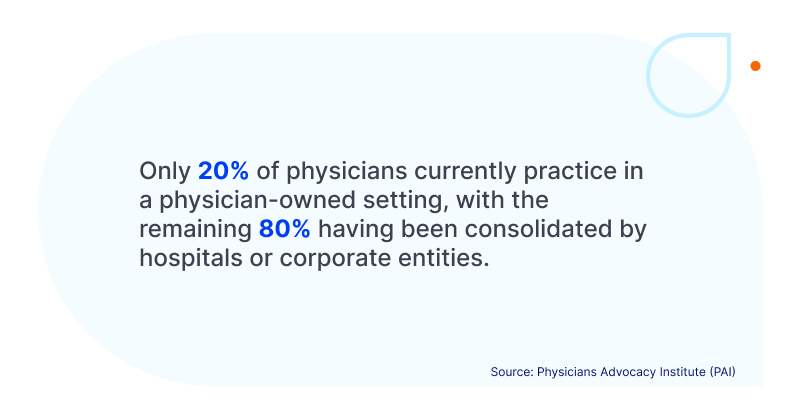
Some sources claim an even higher number of consolidated doctors. For instance, a 2024 report by the Physicians Advocacy Institute (PAI) states that nearly 80% of physicians are employed either by hospitals or corporate entities, leaving only 20% of physicians practicing in a physician-owned setting.
At the same time, patient expectations have migrated out of the clinic and into the consumer economy. An Accenture study, as reported by the American Academy of Professional Coders (AAPC), found that access, ease of doing business, digital patient engagement, and trust are what drive loyalty from patients. To them, a seamless, satisfying healthcare experience is more important than price.
The convenience bar set by every other industry has reset what patients expect before they ever meet a clinician. Better-resourced competitors are spending heavily to meet rising expectations, while patients increasingly judge every provider against the frictionless experiences they get everywhere else.
The good news is that patient loss rarely comes from a single dramatic failure. Instead, it’s usually rooted in accumulated friction. This friction is something any practice can systematically remove. Let’s break down exactly where independent practices leak patients and what closing each gap requires.
Scheduling Friction Sends Patients to Whoever Has the Easiest Access
When patients need an appointment, they seek whoever can serve them with the least friction. This means features such as 24/7 online scheduling, same-day or next-day availability visible immediately, and automated appointment confirmation and reminders.
For large health systems and retail clinics that’ve invested heavily in digital scheduling, this type of appointment access is effortless. But independent practices that require phone calls during business hours, have online scheduling that shows no availability, or lack automated confirmation sequences lose patients to those large competitors at the moment of scheduling intent. These patients don’t leave because they’re angry or upset. They simply go where access is easiest and never return.
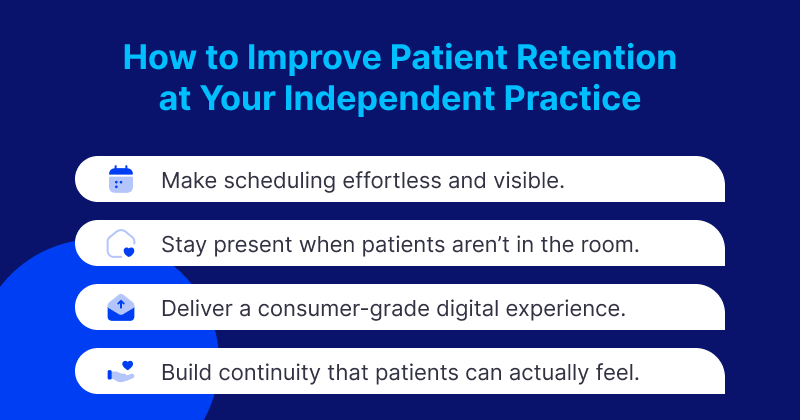
Make Patient Scheduling Effortless and Visible
Closing this gap starts with making scheduling both effortless and visible. That means implementing 24/7 online scheduling that shows real-time availability and confirms the appointment instantly, same-day appointment slots visible in online scheduling for acute care needs, and automated confirmation and reminder sequences that maintain patient engagement through appointment completion. The objective isn’t to add a booking widget for its own sake, but to match the convenience benchmark that retail clinics and health systems have already set without requiring their system-level infrastructure.
When a practice removes that friction, the payoff shows up across the patient journey. Fewer patients leak at the scheduling intent moment when access difficulty would otherwise push them to competitors. Appointment completion rates climb because automated patient engagement keeps booked patients on the calendar. And new patients who once would have bounced off a phone tree now find the practice as easy to reach as any larger competitor.
Communication Gaps Between Visits Erode Patient Experience
In many cases, patients hear nothing from their independent practice between appointments unless they initiate contact. Meanwhile, health systems with active patient engagement programs send care reminders, follow-up communications, and health management prompts that keep the relationship alive.
The independent practice patient relationship exists only at appointment moments, whereas the health system relationship feels continuous. When patients experience this contrast—especially patients comparing care across providers—the independent practice relationship feels thin and transactional while the system relationship feels engaged and invested. And not only do communication gaps frustrate patients, but they also signal that the practice doesn’t think about patients between visits.
Stay Present When Patients Aren’t in the Room
Staying present when patients aren’t in the room is what closes this gap. Proactive outreach programs that maintain patient contact between appointments, automated follow-up communications after visits that extend the encounter into ongoing patient engagement, and reminder campaigns for preventive services, chronic disease management, and wellness all keep the practice visible and demonstrate to patients that their clinicians have an ongoing investment with them. The value of a reminder isn’t only that it improves care adherence. It also keeps patients from feeling abandoned and drifting to a competitor who stays in touch.
Implementing these programs can improve retention because regular, proactive engagement with patients builds a stronger relationship. Patients perceive the practice as an engaged partner invested in their well-being year-round instead of an episodic service they visit when something breaks. That perception is exactly what a well-resourced competitor is trying to manufacture. And it’s something an independent practice can deliver authentically.
Outdated Digital Patient Experiences Are Hurting Independent Practices
When patients compare your digital experience—app quality, patient portal usability, online bill pay ease, communication platform sophistication—to a health system’s app, do they stay, or do they leave? Patients rarely abandon a digital experience over bad UX alone—they abandon it when they compare it to something better.
When a patient’s health system uses a polished consumer-grade app and their independent doctor uses a difficult-to-navigate portal that requires account creation and password recovery to pay a bill, the contrast will be glaring from their perspective. Even if there’s no connection between digital experience quality and clinical quality, patients will make that association. And as consumer digital expectations rise, a dated digital experience makes an excellent practice feel progressively outdated and gives patients a reason to leave that has nothing to do with the care itself.
Deliver a Consumer-Grade Digital Experience
Competing here means delivering an experience that’s mobile-first, intuitive, and fast, with bill payments as simple as any consumer payment app or communication tool. Your digital experience should work the way patients already expect. Treated this way, digital experience stops being a UX project and becomes a competitive signal. It reduces the perception gap with large-system rivals, retains patients who’d otherwise drift toward slicker touchpoints, and reframes the practice in patients’ minds as modern and capable.
Care Continuity Failures Make Patients Feel Like They Have to Start Over
Patients expect providers to remember them. They want their history, their preferences, their ongoing conditions, and their previous conversations to be top of mind. But when patients experience care continuity failures, they lose confidence in the practice’s care coordination. These failures may include arriving for a visit and finding the provider doesn’t know about the specialist they saw last month, discovering that test results from another facility didn’t arrive, or having to re-explain their history at each visit.
Care continuity failures make patients feel invisible rather than known. Large health systems with integrated records create continuity experiences that independent practices can’t match by default because matching them requires deliberate investment in continuity infrastructure.
Build Continuity That Patients Can Actually Feel
Building continuity means aggregating information from every provider into one usable clinical record, preparing providers before each encounter so they walk in with current knowledge of the patient’s status, and capturing care events across settings so they surface back to the primary relationship. The aim here is simply to make patients feel known and heard, no matter how complex their care becomes.
Done well, continuity becomes the stickiest retention force a practice has. A relationship that consistently feels seamless starts to feel irreplaceable, and patients don’t abandon what feels irreplaceable. Continuity failures that would otherwise create an impression of disconnected, impersonal care disappear, and the practice earns a valuable point of differentiation via coordination quality that patients assume only a big system can deliver.
Maintaining Your Practice with the Patient Retention Flywheel
The four areas covered above aren’t separate fixes. They compound into a flywheel. Remove scheduling friction, and more patients stay long enough to experience your communication. Stronger communication deepens the relationship, which makes care continuity feel natural. And once patients feel known and engaged, a digital experience gap becomes far less damaging, because the relationship is doing the retention work the app can’t.
Each improvement feeds into the next, and the whole turns faster than any single fix could on its own.
Close the Patient Experience Gap Before a Competitor Does it for You
You don’t need a large health system’s budget to enable the retention flywheel and deliver the convenience patients are demanding. The right operational foundation working behind the scenes can remove friction at its source. DrChrono by Everhealth brings scheduling, communication, medical billing, and connected care into one platform built to help independent practices build their flywheel so they can close the experience gap, compete, and win. Learn more about DrChrono today.